MOUNTADAPT – A European Research Project at UMFST-UMCH
Climate Resilience in Healthcare: UMFST-UMCH and MOUNTADAPT Exchange Expertise
How can healthcare systems prepare for the growing challenges of climate change? This question was at the heart of a joint academic session hosted by UMFST-UMCH and the European research project MOUNTADAPT on 23 November 2026 at the medical campus in Hamburg. The event highlighted the importance of climate-resilient healthcare systems and explored innovative approaches to ensuring sustainable, future-ready medical care.
Climate Change as a Challenge for Healthcare Systems
Rising temperatures, extreme weather events and changing environmental conditions are presenting healthcare systems with new challenges. Raising awareness of the relationship between climate change, human health and medical care is therefore becoming increasingly important in medical education.
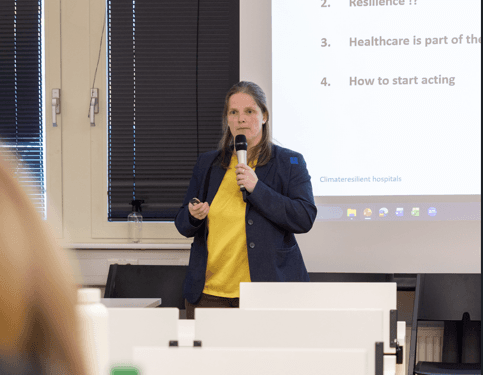
The joint academic session opened with a lecture by Dr. med. Andrea Nakoinz entitled “Climate-Resilient Healthcare”. Her presentation focused on the importance of building healthcare systems that can adapt to changing climatic conditions and continue to provide reliable patient care, even under challenging circumstances.
MOUNTADAPT – A European Research Project for Climate-Resilient Healthcare
Following the opening lecture, Magalie Michalak from the Senate Chancellery of the Free and Hanseatic City of Hamburg introduced the EU-funded research project MOUNTADAPT in her presentation entitled “Climate Resilience in Healthcare”.
Funded through the European research and innovation programme Horizon Europe, MOUNTADAPT brings together 27 partners from across Europe with the shared objective of strengthening the resilience of healthcare systems against the impacts of climate change.
The project focuses on developing innovative early warning systems, improving medical emergency management, providing targeted training for healthcare professionals and raising public awareness of climate-related health risks. MOUNTADAPT emphasises interdisciplinary collaboration between scientific institutions, healthcare organisations and public authorities.
The Free and Hanseatic City of Hamburg also plays an important role within the project. As a replication site, Hamburg provides an opportunity to transfer climate adaptation measures originally developed for European mountain regions to an urban healthcare system and assess their applicability.
Shaping the Future of Healthcare Together
The joint academic session was a successful example of collaboration between UMFST-UMCH and MOUNTADAPT, demonstrating the value of knowledge exchange between university education, European research initiatives and public institutions.
For medical students at the Hamburg campus, the event provided an opportunity to explore the health impacts of climate change and innovative approaches to addressing these challenges early in their medical studies.
By integrating such forward-looking topics into its medical curriculum, UMFST-UMCH promotes a holistic understanding of medicine that extends beyond everyday clinical practice and encompasses global, societal and environmental challenges.