



Recognized in India, USA, UK, EU and more
Job prospects
Visa security
Study medicine (MBBS) in Germany at an English-taught campus with hands-on clinical training
UMFST-UMCH offers NEET-qualified Indian students an international pathway to study medicine beyond the limitations of MBBS seats in India.

Internationally recognized & accredited
UMFST-UMCH holds top-tier accreditations and certifications from globally respected institutions.
Let’s Talk Medicine
Meet our Indian student counsellor online or on campus and receive personal guidance in English, Hindi, or Bengali.
Admission datesOnline or on-site at the campus
Wed
4 November 2026
Wed
11 November 2026
Sat
14 November 2026
Apply Now
Transfer student?
Why Indian students choose UMFST-UMCH
International medical education, strong clinical training, and a global career pathway beyond limited MBBS seats in India.
From NEET to an international medical career
Discover a global medical education pathway in Hamburg at UMFST-UMCH for Indian students.
Campus Video
Why study in Germany?
A look behind the scenes - Campus, Teaching & Student Life
Quick facts about studying
at UMFST-UMCH

Program Start
Annually at the end of September

Language of Instruction
English for classes
(German or Spanish in teaching hospitals)

Duration of Study
6 years (12 semesters)

ECTS Credits
360 ECTS credits

Admission Requirements
A-Levels, IB, CBSE, CISCE, HSC or other final high school diploma

Admission Process
Online application, motivation-based interview & short evaluation in English
All you should know to study abroad:
Find answers about NEET requirements, NMC guidelines, FMGE/NExT pathways, student visas, and studying medicine in Europe after NEET.
The medical program at UMFST-UMCH lasts 6 years (12 semesters) and is equivalent to MBBS.
Yes. Students receive hands-on clinical training and hospital-based practical education as part of their medical studies in Europe.
According to updated NMC guidelines, mid-course transfers between foreign medical universities may affect eligibility and recognition in India.
Clinical and practical medical training takes place physically in clinical and hospital environments, as required by NMC guidelines.
Indian students choose UMFST-UMCH for its English-taught medical program, international learning environment, clinical training opportunities, transparent admission process, and global medical career orientation.
No, the MBBS program at UMFST-UMCH is fully taught in English. German language training is included during your studies.
No additional licensing exam is required, but you need C1-level German proficiency to practice medicine in Germany.
Yes, the degree from UMFST-UMCH is recognized by the National Medical Commission (NMC) and listed in the World Directory of Medical Schools, allowing Indian graduates to take the FMGE exam.
Yes, the UMFST-UMCH medical degree is recognized across the EU and many countries and allows eligibility for exams like USMLE (USA) and opportunities worldwide.
More information >
Yes. The medical program follows the updated NMC requirements, including the mandatory academic duration and clinical training components required for Indian students pursuing medicine abroad.
Indian students graduating from internationally recognized medical programs may pursue the FMGE/NExT pathway according to future NMC regulations and licensing requirements in India.
FMGE is currently the screening examination for foreign medical graduates in India. The National Exit Test (NExT) is expected to replace FMGE as the future licensing examination pathway.
Yes, Indian students must qualify for NEET to apply for the 6-year MBBS program at UMFST-UMCH.
Yes, you can directly apply to UMFST-UMCH after completing your 12th grade (CBSE, ISC, or equivalent) without a foundation year.
The admission process at UMFST-UMCH is fully online and includes:
- Application submission
- Online evaluation (Biology, Chemistry, General Knowledge)
- Motivation-based interview
For many Indian students, studying medicine in Germany offers an international alternative to limited MBBS seats in India, with modern infrastructure, global exposure, and practical clinical education.
For Indian students the tution fees are:
€17,400 per semester (12 semesters)
€4,500 one-time enrollment fee
€595 application fee
More information >
The cost of living for Indian students studying in Hamburg is manageable compared to other major European cities, especially considering the high quality of life and student support available. On average, students should plan a monthly budget that covers accommodation, daily expenses, transportation, and personal needs.
Accommodation is typically the largest expense, with student housing or private apartments ranging from €800 to €1,000 (₹ 89.000 to ₹110.000) per month, depending on the location and type of accommodation. Many students choose university-recommended residences or shared apartments to optimize costs and convenience.
In addition, general living expenses - including food, groceries, health insurance, study materials, and leisure activities - usually range between €300 and €600 per month, depending on individual lifestyle. Hamburg also offers excellent public transportation , and students benefit from a semester ticket that allows affordable or even free travel across the city and beyond.
Yes, Hamburg is considered one of the safest cities in Germany with a high quality of life, making it ideal for international students.
More information >
Yes, Hamburg is considered one of the safest cities in Germany with a high quality of life, making it ideal for international students.
More information >
UMFST-UMCH supports students with housing partnerships, but early application is recommended due to high demand.
More information >
Yes, the campus cafeteria offers vegetarian and halal meal options daily for international students.
Yes. International students in Germany can work up to 120 full days or 240 half days per year during their studies.
Germany allows family reunification for eligible residents and professionals under applicable immigration regulations.
Yes, a German student visa is mandatory. The process can take several months, so early application is recommended.
Key requirements include:
- Valid passport
- APS certificate
- Admission letter from UMFST-UMCH
- Proof of funds (blocked account)
- Health insurance
Yes, graduates can apply for permanent residency after working in Germany, often within about 21 months with a Blue Card.
Yes. Graduates may apply for an 18-month residence permit to search for employment opportunities in Germany after completing their studies.
Yes. Medical residency training in Germany is generally a paid hospital employment position.
Resident doctors in Germany typically earn approximately €4,500–€6,000 gross per month, depending on the hospital and specialization.
Yes. Graduates may explore residency and career opportunities in Germany according to applicable licensing and language requirements.
The EU Blue Card is a residence and work permit option for qualified professionals, including doctors working in Germany.
After graduating from UMFST-UMCH, students receive a medical degree that can open pathways toward residency training, clinical practice, research, and healthcare-related careers in Germany and internationally.
The typical next steps include:
- Completing the degree and graduation requirements
- Applying for medical licensure/recognition in the country where you wish to practice
- Applying for residency training (specialization)
- Starting professional practice or further academic training
For graduates who want to continue in Germany, the process usually involves obtaining:
- Degree recognition
- Medical licensure (Approbation)
- German language certification (typically B2/C1 Medical German)
- Residency placement in a hospital or clinic
Residency training in Germany is called “Facharztausbildung” (specialist training). During this period, doctors work in hospitals or clinics while training in a chosen medical specialty.
Unlike some countries, residency in Germany is employment-based. This means residents are salaried doctors from the beginning of their training.
Medical German/Fachsprachprüfung: C1 Medical German.\n\nStrong communication skills are essential for patient care and professional integration.
No. Germany does not use a centralized residency match system. Graduates apply directly to hospitals and clinics for residency positions. This allows students greater flexibility when applying to different regions and specialties.
Medical graduates can pursue many different career pathways, including:
Clinical Careers
- Residency training in hospitals
- General practice/family medicine
- Specialized medical practice
- Emergency medicine
- Intensive care medicine
Academic & Research Careers
- Clinical research
- Biomedical sciences
- University teaching
- PhD and doctoral programs
- Public health research
Healthcare Industry Careers
- Pharmaceutical companies
- Medical technology companies
- Healthcare consulting
- Clinical trials management
- Medical affairs
International Opportunities
- Medical practice in other countries
- Global health organizations
- NGOs and humanitarian medicine
- International research collaborations
Yes. Career opportunities depend on the recognition rules of each country. Graduates should always verify the licensing and recognition requirements of the country where they plan to practice.
Start your medical studies in 3 simple online steps
Complete the entire application process online from the comfort of your home. No need to travel for entrance exams or interviews.
Boost your chances
The perfect application timeline and country requirements for future Indian students.
Premium medical education with global career flexibility
Comparing UMFST-UMCH and private medical colleges in India.
| Factor | Private medical colleges in India | UMFST-UMCH – Germany |
|---|---|---|
| Language of instruction | Mostly English | Fully English-taught program |
| Location | India | Germany, European Union |
| Clinical exposure | Often later-stage clinical exposure | Early practical training inGerman teaching hospitals |
| Healthcare environment | Varies significantly by institution | Modern European healthcare infrastructure |
| International career opportunities | Primarily India-focused | Germany, Europe & international pathways |
| Degree structure | Indian medical education system | European medical education framework |
| Admissions process | Highly competitive seat allocation | |
| NEET context | Limited availability of private seats | Suitable for NEET-qualified students |
| Tuition transparency | Variable costs, often including capitation or donation-based fees | Transparent, fixed, and predictabletuition structure |
| Living costs | Depends on city & institution | Predictable European living expenses |
| Long-term value | Primarily domestic career pathway | International exposure & career flexibility |
| Student support | Institution dependent | International student environment |
Language of instruction
UMFST-UMCH – Germany
Fully English-taught program
Private medical colleges in India
Mostly English
Location
UMFST-UMCH – Germany
Germany, European Union
Private medical colleges in India
India
Clinical exposure
UMFST-UMCH – Germany
Early practical training inGerman teaching hospitals
Private medical colleges in India
Often later-stage clinical exposure
Healthcare environment
UMFST-UMCH – Germany
Modern European healthcare infrastructure
Private medical colleges in India
Varies significantly by institution
International career opportunities
UMFST-UMCH – Germany
Germany, Europe & international pathways
Private medical colleges in India
Primarily India-focused
Degree structure
UMFST-UMCH – Germany
European medical education framework
Private medical colleges in India
Indian medical education system
Admissions process
UMFST-UMCH – Germany
Private medical colleges in India
Highly competitive seat allocation
NEET context
UMFST-UMCH – Germany
Suitable for NEET-qualified students
Private medical colleges in India
Limited availability of private seats
Tuition transparency
UMFST-UMCH – Germany
Transparent, fixed, and predictabletuition structure
Private medical colleges in India
Variable costs, often including capitation or donation-based fees
Living costs
UMFST-UMCH – Germany
Predictable European living expenses
Private medical colleges in India
Depends on city & institution
Long-term value
UMFST-UMCH – Germany
International exposure & career flexibility
Private medical colleges in India
Primarily domestic career pathway
Student support
UMFST-UMCH – Germany
International student environment
Private medical colleges in India
Institution dependent
UMFST-UMCH Insights
Authentic insights into life as an international student at UMFST-UMCH.
Information package for your studies
Your journey into higher education – informed and guided from the start.
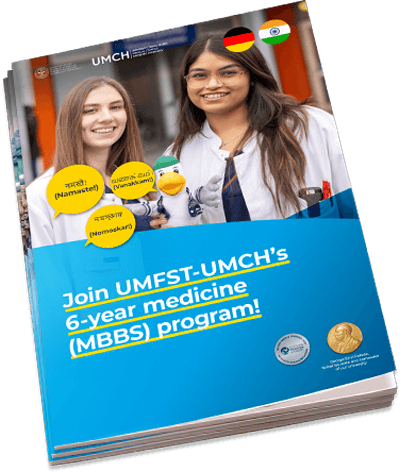
Your guide to studying medicine in Hamburg
All the key information – summarised for you in a concise format.
Your guide to studying medicine at UMFST-UMCH. Find out everything you need to know about the course structure, the application process, and student life in Hamburg.
Fill out the form to receive the guide
More than a degree – a community that feels like home
A strong and connected Indian community that brings culture, support, and belonging to campus life.


