Bodypainting Workshop: Anatomy Brought to Life
With color, creativity, and great enthusiasm, Assoc. Prof. Dr. Lorand Denes brings fresh energy to anatomy teaching at UMFST-UMCH. The anatomy lecturer uses body painting as an innovative educational tool to present complex structures of the human body in a vivid, memorable, and practice-oriented way.
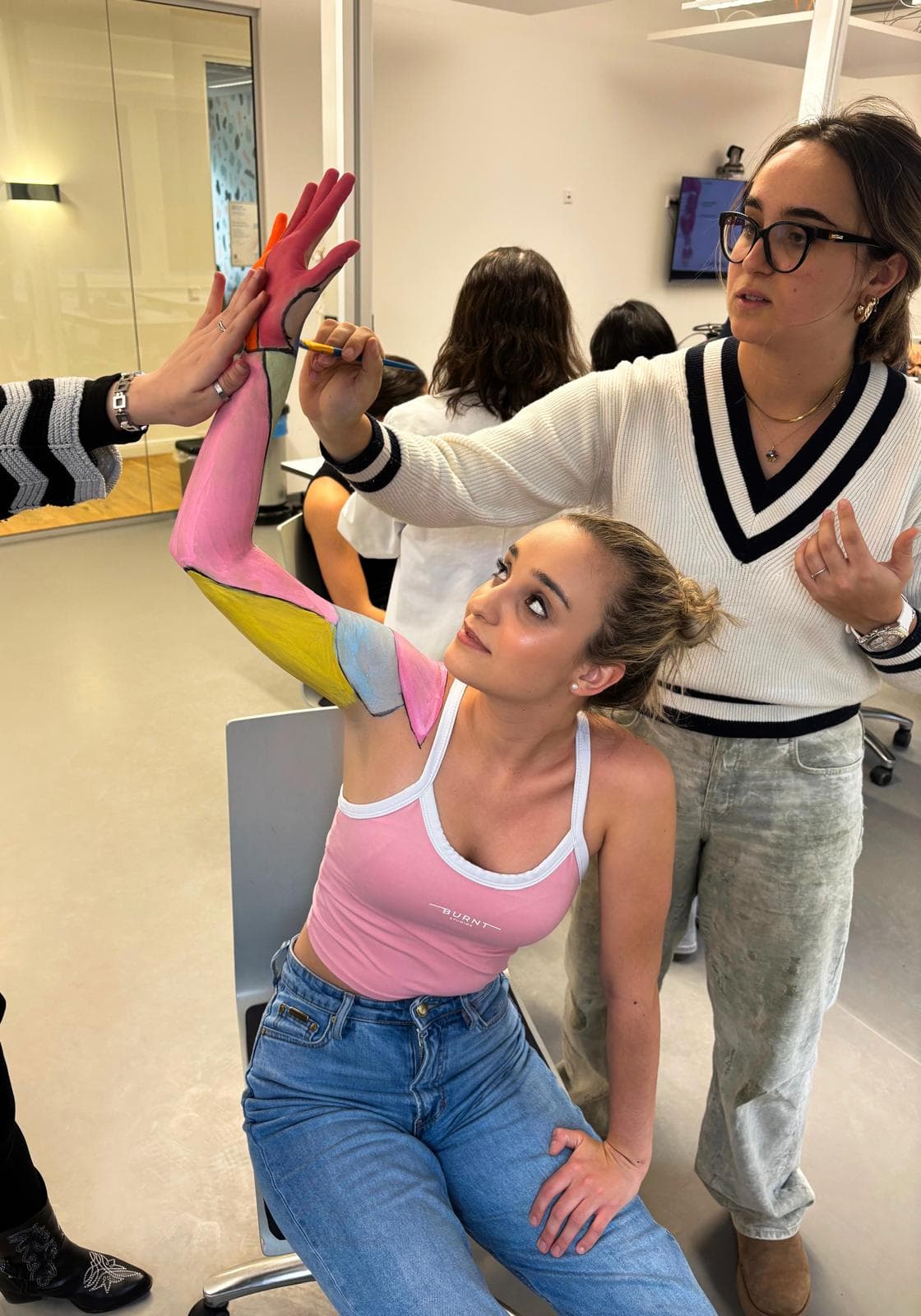
As part of an extracurricular body painting workshop, second-year students were given the opportunity to experience anatomy in an unconventional and engaging manner. The workshop focused on the peripheral sensory innervation of the limbs. Segmental and nerve-based maps were painted directly onto the students’ arms and legs, allowing anatomical relationships to be visualized and more effectively retained.
Assoc. Prof. Dr. Lorand Denes is a professor at the Institute of Anatomy at the Romanian main campus of UMFST in Târgu Mureș. He has dedicated more than 25 years to the field of anatomy, a passion that continues to drive his work today. “I am also proud to have been among the first lecturers who helped establish the educational process here at UMCH in 2019,” he says. In addition to his academic role, Prof. Denes works as a radiologist, enabling him to integrate clinically relevant knowledge and real-life case examples directly into his teaching.
Interview with Assoc. Prof. Dr. Lorand Denes
What inspired you to introduce an anatomical body painting workshop?
As an educator, I am constantly seeking ways to improve the learning process. Research clearly shows that a “hands-on” approach, which actively involves students, significantly enhances information retention and learning outcomes. Body painting is an excellent method for demonstrating anatomical structures directly on the skin. It also trains attention to detail and encourages observations that might otherwise be overlooked. At the beginning of the workshop, I provide a brief introduction to the topic and actively guide the students throughout the painting process to ensure anatomical accuracy. At the end, we analyze and discuss the anatomy represented in the completed “painting.”
What added value does the workshop offer students?
The students become thoroughly familiar with the anatomical topics presented, including fine details that will be highly relevant in clinical practice. At the same time, they gain early experience working with the human body and are encouraged to connect clinical findings—obtained through observation and palpation—with their anatomical knowledge. The workshop therefore serves as an excellent introduction to physical examination and lays a solid foundation for the clinical years.